
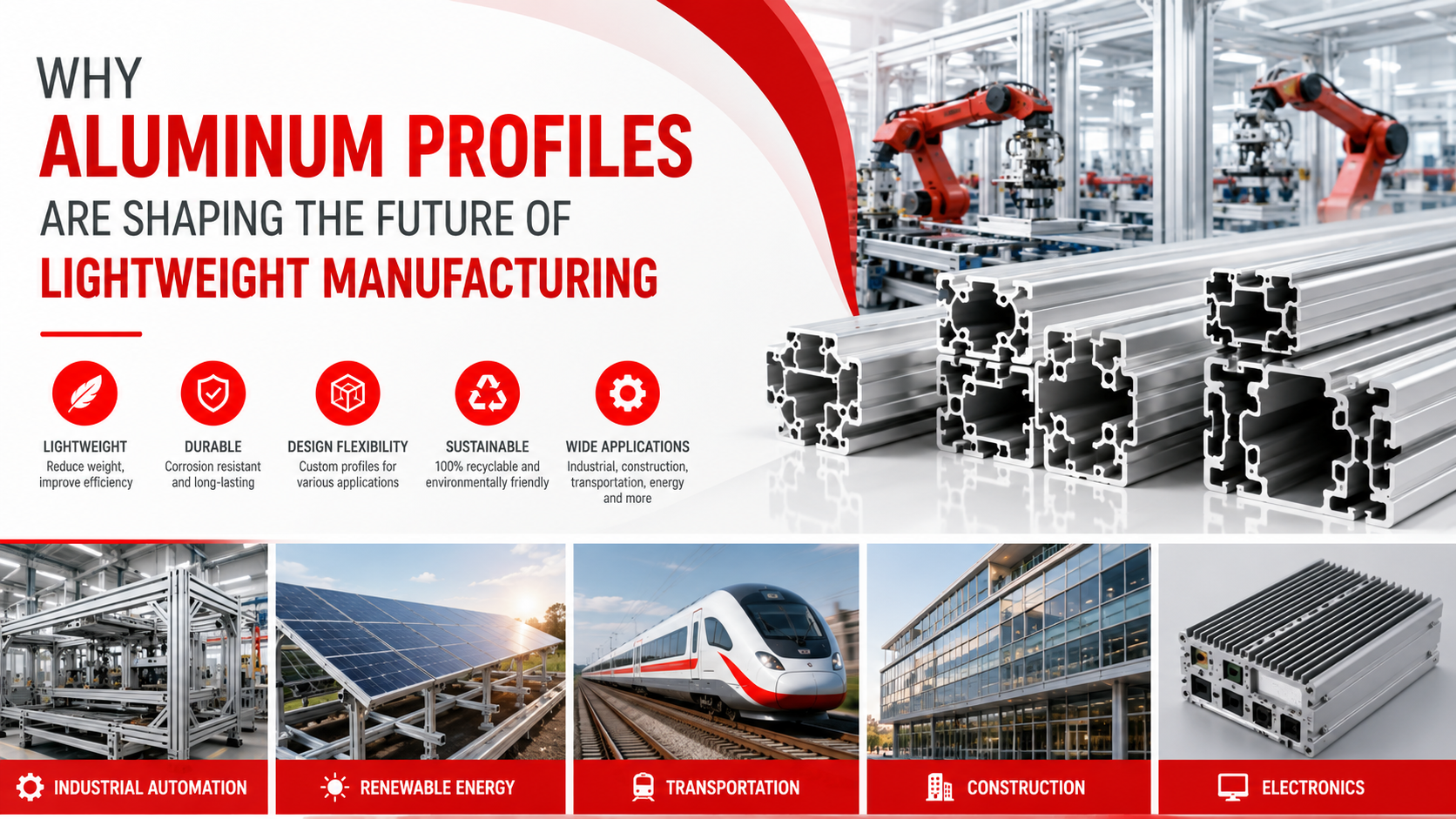
Why Aluminum Profiles Are Shaping the Future of Lightweight Manufacturing
Global industries are moving toward lighter, more efficient, and more sustainable manufacturing solutions.
From industrial automation and renewable energy to transportation, construction, electronics, and equipment manufacturing, companies are looking for materials that can reduce weight while maintaining strength, durability, and design flexibility.
Aluminum profiles are playing an increasingly important role in this transformation.
With their lightweight structure, corrosion resistance, machinability, recyclability, and flexible cross-sectional design, aluminum profiles provide practical solutions for a wide range of industrial applications.
The Growing Demand for Lightweight Materials
Lightweight design has become an important direction in modern manufacturing.
Reducing product weight can help companies:
- Lower transportation costs
- Improve energy efficiency
- Simplify installation and assembly
- Reduce equipment load
- Improve product handling
- Increase design flexibility
- Support sustainable manufacturing goals
Compared with many traditional structural materials, aluminum offers a favorable balance between weight, strength, durability, and processing performance.
This makes it suitable for both structural and decorative applications.
Flexible Custom Extrusion Design
One of the major advantages of aluminum is its ability to be extruded into complex cross-sectional shapes.
Custom aluminum extrusion allows several functions to be integrated into one profile, including:
- Structural support
- Screw channels
- Internal ribs
- Cable management
- Heat dissipation
- Assembly grooves
- Decorative surfaces
- Connection points
By combining multiple functions within one extrusion, customers can reduce the number of individual components required for assembly.
This can simplify product design, shorten assembly time, and improve overall manufacturing efficiency.
Aluminum Profiles for Industrial Automation
Industrial aluminum profiles are widely used in modern production systems.
Typical applications include:
- Machine frames
- Safety guards
- Conveyor systems
- Workstations
- Equipment enclosures
- Inspection systems
- Modular production lines
- Automated assembly systems
The modular nature of aluminum profiles makes industrial equipment easier to install, modify, expand, and maintain.
For manufacturers that regularly adjust production layouts, this flexibility can provide significant long-term value.
Supporting Renewable Energy Development
The renewable-energy industry requires materials that are durable, lightweight, corrosion-resistant, and suitable for long-term outdoor use.
Aluminum profiles can be used in:
- Solar panel frames
- Photovoltaic mounting systems
- Energy storage equipment
- Charging facilities
- Electrical enclosures
- Structural support components
- Battery-related products
The corrosion resistance and recyclability of aluminum make it well suited for clean-energy applications.
As the renewable-energy sector continues to grow, demand for customized aluminum components is expected to remain strong.
Lightweight Solutions for Transportation
Reducing structural weight is an important objective in transportation manufacturing.
Lighter components can help improve energy efficiency, reduce operating loads, and support easier installation.
Aluminum profiles can be used in:
- Automotive components
- Commercial vehicle structures
- Rail transportation systems
- Battery enclosures
- Interior structural parts
- Roof systems
- Equipment frames
- Protective housings
Custom extrusion also allows manufacturers to combine structural strength and functional features within one component.
Aluminum Profiles in Construction
Aluminum remains an important material for architectural and construction applications.
It is commonly used in:
- Windows and doors
- Curtain wall systems
- Partitions
- Railings
- Facade systems
- Furniture
- Interior decoration
- Commercial building systems
Aluminum profiles offer durability, low maintenance requirements, design flexibility, and a wide range of surface finishing options.
These characteristics make them suitable for modern architectural projects.
Electronics and Thermal Management
Aluminum has good thermal conductivity and can be designed with fins, channels, and other heat-dissipation structures.
It is therefore widely used for:
- Heat sinks
- LED housings
- Electronic enclosures
- Power supply housings
- Communication equipment
- Control systems
- Battery components
- Industrial electronics
Custom aluminum extrusion can combine thermal management, structural support, and exterior protection in one finished component.
Surface Finishing for Performance and Appearance
Surface treatment can improve the appearance, corrosion resistance, wear resistance, and service life of aluminum profiles.
CHANTA ALU can support finishing options such as:
- Anodizing
- Powder coating
- Electrophoretic coating
- Brushing
- Polishing
- Sandblasting
- Decorative finishes
Different finishes can provide various colors, textures, gloss levels, and performance characteristics.
The appropriate treatment depends on the product application, operating environment, and appearance requirements.
Precision Processing for Finished Components
Many B2B customers require more than basic extrusion lengths.
They may need aluminum profiles that are ready for assembly or final product manufacturing.
Our secondary processing capabilities include:
- Precision cutting
- CNC machining
- Drilling
- Tapping
- Punching
- Bending
- Milling
- Deburring
- Inspection
- Customized packaging
By integrating extrusion and precision processing, customers can reduce supplier coordination and improve dimensional consistency.
Aluminum and Sustainable Manufacturing
Aluminum is recyclable and can be reused while retaining many of its essential properties.
Efficient profile design can also reduce unnecessary material consumption.
Additional sustainability advantages may include:
- Long product service life
- Corrosion resistance
- Lower structural weight
- Reduced transportation load
- Material recyclability
- Efficient manufacturing
- Reduced component quantity through integrated design
These characteristics make aluminum an important material for industries focused on energy efficiency and long-term sustainability.
How CHANTA ALU Supports Lightweight Manufacturing
CHANTA ALU provides one-stop aluminum profile solutions for global B2B customers.
Our services cover:
- Design and manufacturability review
- Die development
- Aluminum extrusion
- Heat treatment
- Surface finishing
- Precision cutting
- CNC machining
- Drilling and tapping
- Punching and bending
- Quality inspection
- Customized packaging
- Global delivery support
We support projects from initial design evaluation and sample development to mass production and repeat supply.
Our goal is to help customers achieve a balance between performance, weight, cost, production efficiency, and reliable delivery.
Start Your Lightweight Aluminum Project
To receive a project evaluation, customers can provide:
- Product drawings or samples
- Required aluminum alloy
- Profile dimensions
- Product length
- Dimensional tolerances
- Surface finishing requirements
- Machining requirements
- Estimated order quantity
- Packaging standards
- Delivery destination
Our team will review the project and recommend a suitable aluminum profile solution.
Contact CHANTA ALU today to discuss your next lightweight manufacturing project.
CHANTA ALU — One-Stop Aluminum Profile Solutions, From Design to Delivery.